Runners need one toilet per roughly 100 to 150 entrants along the course, plus extra at start and finish corrals. South Fulton Porta Pros builds race restroom plans around field size, course length and aid station spacing, with standard units delivered days ahead for staging.
Field size drives the count more than distance does. A 500-runner 5k needs fewer units than a 500-runner marathon, because the marathon keeps people on course, and near restrooms, for hours longer. OSHA 1926.51(c) sets a construction benchmark of one toilet per 20 workers, and race organizers use it as a rough floor when nothing else applies. Most South Fulton race directors we work with land on one unit per 100 to 150 participants at the start corral, then thin that out to one every mile or two along the route near aid stations. Add units at the finish line separate from the start bank; runners cluster there for 30 to 60 minutes after crossing, and lines back up fast. If the course threads through South Fulton toward East Point, 11.3 miles east, plan a cluster there too, since that stretch often becomes a natural aid station point. For events expecting wheelchair or handcycle divisions, ADA accessible units are required under ADA Standards 213.2, which calls for at least 5 percent of clustered units to be accessible, never fewer than one. Check our placement guide before you finalize the site map, and use the how many porta potties do I need breakdown if your field size sits outside typical ranges.
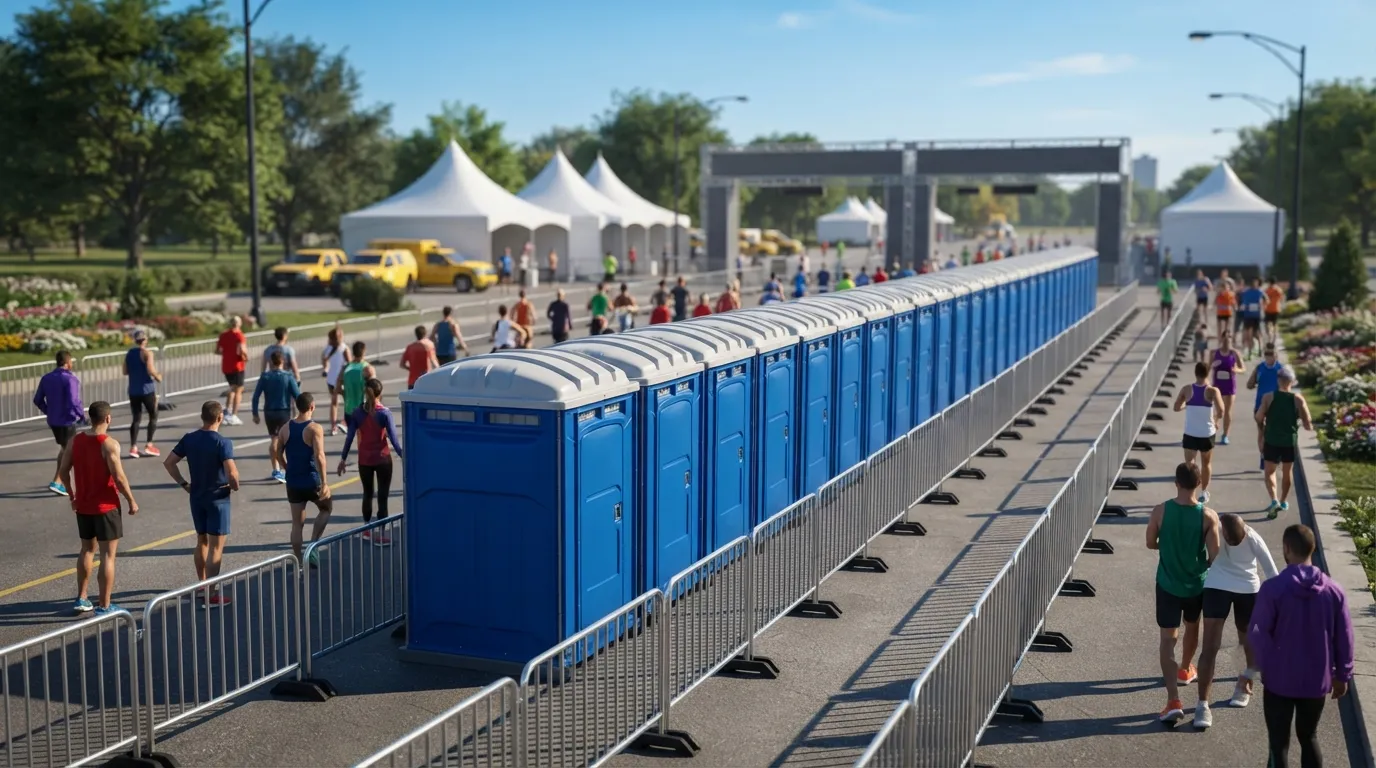
Pricing depends on unit type, event length and how many stations you're running at once. A single-day standard unit typically runs in the range below; race-week logistics or overnight staging change that math, so ask about per-day rates versus event pricing.
| unit | duration | typical price |
|---|---|---|
| standard | day | $150 |
| standard | event | $400 |
| ada | day | $230 |
| delivery_fee | day | $150 |
Event-day pricing for standard units reflects the extra service visits, staffing and short lead time that race weekends demand. If your race spans a full weekend with a Saturday shakeout run and Sunday main event, ask about weekend event bundles rather than paying two separate day rates. For multi-station races, restroom trailers at the finish line give VIP runners and staff a nicer option than a bank of standard units, and a 2 stall or 4 stall trailer handles staff and sponsor tents well. Check event restroom rental for combined pricing across restrooms, handwashing and fencing, since most race directors bundle all three into one delivery.
Most standard units need no hookup at all; they run on a self-contained 60 to 70 gallon holding tank, which is one reason they work well for point-to-point courses without utility access. But finish-line festivals often need a bit more. If your race staging area needs lighting for a pre-dawn start, a light tower rental covers that, and if timing equipment or a sound system needs power, a temporary power pole delivers service without running a generator all day. How to brace a temporary power pole matters here: poles need a stable base, guy wires or a properly compacted backfill around the mounting sleeve, and they should never sit on grass alone near a crowd corridor, since foot traffic and wind load both push against an unbraced pole. Our crews check bracing on delivery and again before race start. For crowd management along chutes and near timing mats, temporary fencing or crowd control barrier keeps runners funneled correctly, and chain link fencing secures equipment overnight if your event spans two days. Handwashing matters too: 29 CFR 1910.141(d)2 requires soap and towels or a hand-drying device at wash stations, not sanitizer alone, so pair units with a handwashing station or portable sink rather than relying on gel dispensers.
South Fulton's road network makes staging straightforward for most courses, but delivery trucks still need clearance. Roll-off and trailer deliveries need about 60 feet of straight clearance behind the truck, so scout your drop points before race morning rather than during setup. If your race draws runners from Douglasville, 12.6 miles northwest, or Fayetteville, 19.1 miles southeast, mention that in your event listing; out-of-town racers plan around drive time and often ask about parking near restroom clusters.
Book 4 to 6 weeks ahead for races over 500 runners, sooner if your date falls near a holiday weekend. Smaller local races can often book 2 weeks out. Check emergency porta potty rental if your date moved and you're under a week out.
Yes, and most races should. Splitting units between start and finish, rather than one central bank, cuts walk time and keeps corrals moving. See our placement guide for spacing recommendations.
Yes. ADA Standards 213.2 requires at least one accessible unit in any cluster, and 5 percent minimum for larger deployments. Ramp slope for accessible units follows ADA 405.2, no steeper than 1:12.
Units stay functional in rain; the concern is footing near entrances. Crews check placement on stable, level ground per ADA 302.1 surface standards before race morning to avoid mud buildup at doorways.
Yes. Many South Fulton races pair restroom clusters with a roll-off dumpster at the finish festival area. Ask about combined delivery to cut your total delivery fee.
Yes. South Fulton Porta Pros delivers marathon and race restrooms across South Fulton and the surrounding metro, with same-day and next-day drop-off available on most orders.
Pricing depends on the unit and how long you need it. See our cost breakdown and request a free quote for an exact figure.
Standard rentals include scheduled service — a pump-out, a clean, a restock and fresh deodorizer. Busy or hot-weather sites can be serviced more often.
Call now or request a free quote — clean units, on-time delivery, transparent pricing.