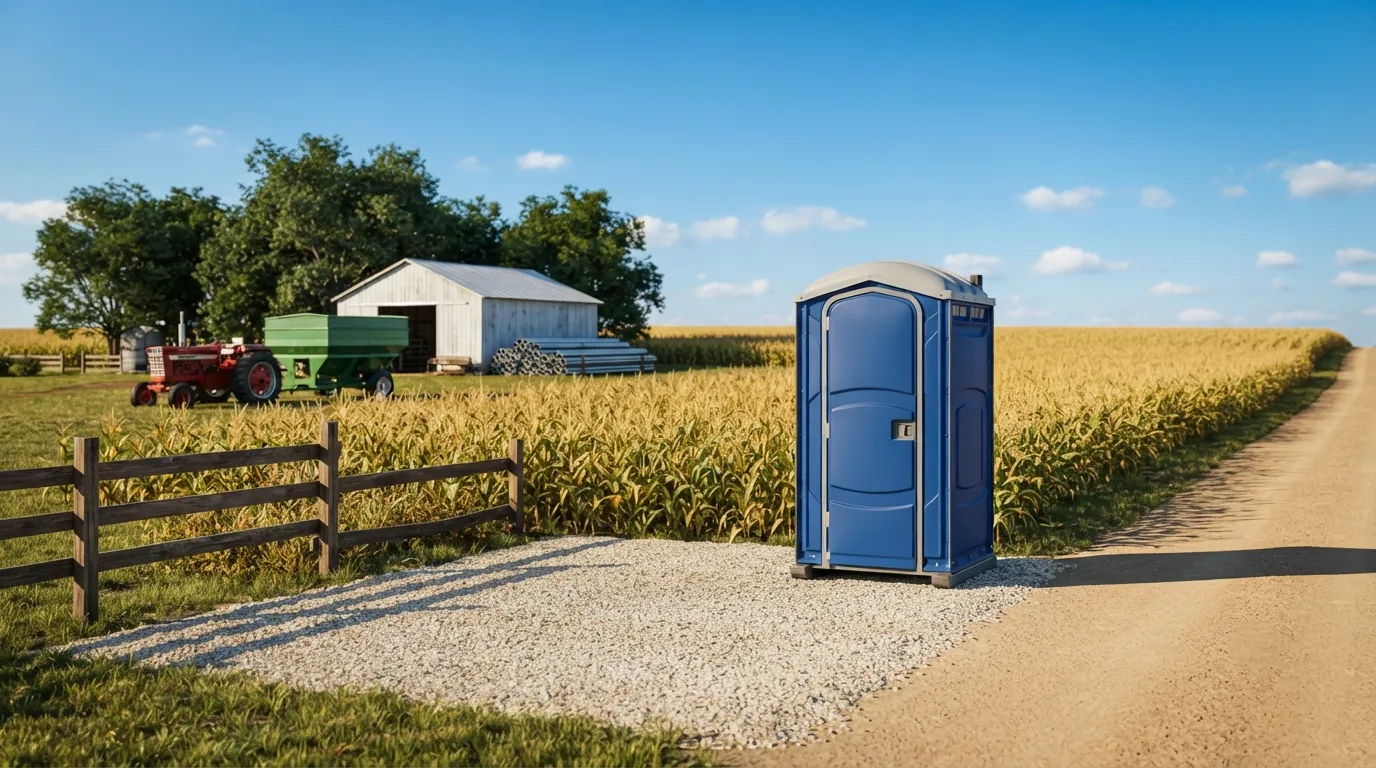
Farm and agricultural restrooms in South Fulton run on a simple rule: one facility per 20 hand-labor workers, placed within a quarter mile walk, per OSHA 1928.110. South Fulton Porta Pros sets up standard units, handwashing stations and holding tanks for row crop operations, pastureland and packing sheds across the county.
Start with OSHA 1928.110, the field sanitation standard written specifically for agriculture. It calls for potable water, toilet facilities and handwashing within a quarter mile walk of where hand-labor employees are working, at a ratio of one facility per 20 workers. That is different from the construction ratio in OSHA portable toilet requirements, which uses OSHA 1926.51(c): one toilet for 20 workers or fewer, then one seat and one urinal per 40 workers as the crew grows past that. Most South Fulton farms fall under the ag standard, not the construction one, but a farm running a packing operation with fixed crews might want to check how many porta potties do I need against both. A standard porta potty rental with a 60 to 70 gallon holding tank covers a typical field crew for a week between services under the ANSI/PSAI Z4.3 baseline interval, which assumes up to 10 users over a 40 hour week. Larger crews or longer rows mean more units, not longer service gaps. Spread multiple units along the field edge rather than clustering them at one gate, since the quarter mile walk limit applies to wherever the crew actually is, not just the staging area. For seasonal harvest work with 30 or more hand-labor employees, run the math early and place a portable toilet rental order before the crew shows up, not after.
Handwashing on a farm isn't optional, and OSHA draws a line between routine field handwashing and the washing required after chemical exposure. General field sanitation handwashing falls under 1928.110. But if your crew is applying paints, coatings, herbicides or insecticides, OSHA 1926.51(f)(1) kicks in and requires washing facilities specifically because of that contaminant exposure. A handwashing station rental or portable sink rental satisfies both. Under 29 CFR 1910.141(d)(2), any washing facility needs soap and towels or a hand-drying device; hand sanitizer alone does not meet that standard, so a hand sanitizer station rental works as a supplement, not a substitute, when herbicide or insecticide crews are on site. OSHA 1926.51(a)(1) also requires an adequate supply of potable water at any place of employment, which matters for irrigation crews and packing sheds alike. If your farm sits near a septic system for the farmhouse or a bunkhouse, that's a separate track: a typical residential tank needs pumping every 3 to 5 years depending on tank size and household size, and septic pumping service or how often to pump a septic tank covers that side of things. Farms running a wash station or dairy operation with grease buildup should also look at grease trap pumping, since a grease interceptor needs pumping once fats, oils, grease and solids reach 25 percent of liquid depth.
Farm rentals usually run on a weekly or monthly cycle rather than a single event day, since crews are in the field for a season, not a weekend.
| unit | day | week | month |
|---|---|---|---|
| standard | $100 - $350 | $130 - $500 | $125 - $325 |
| deluxe | $85 - $1200 | $150 - $290 | - |
A standard unit is the right call for most row crop and pasture work. Farms wanting a flushable option for a packing crew or farm store staff should look at deluxe flushable porta potty instead. Delivery adds a separate fee, typically $50 to $150 for a weekly delivery window, and that's worth confirming when you request a quote since driveway length and field access affect it. Operations near Fayetteville, about 19.1 miles southeast of South Fulton, or Douglasville, 12.6 miles northwest, fall inside our regular delivery routes, so distance rarely changes the delivery fee much within the county. For full pricing detail across unit types, see porta potty rental cost or monthly porta potty rental if your season runs long.
Placement rules depend on whether the unit sits on private agricultural land or near a public road. On private farmland, permitting is rarely an issue, but placement near a right of way should be confirmed with the city. Check porta potty permit requirements before delivery day.
Not if the fields are far apart. OSHA 1928.110 requires a facility within a quarter mile walk of each work crew, so scattered fields usually need separate units. Talk through your layout using porta potty placement guide before ordering.
Weekly service is the baseline under ANSI/PSAI Z4.3 for a unit handling about 10 users across a 40 hour week. Larger crews need more frequent visits. See how often are porta potties cleaned for what a service visit covers.
A standard unit carries a 60 to 70 gallon holding tank, enough for a week of moderate use. Remote sites far from a service route sometimes need a holding tank rental instead, sized for less frequent pickup.
Yes. South Fulton Porta Pros serves farm operations throughout South Fulton and nearby, including sites near East Point, 11.3 miles east, and Mableton, 15.8 miles north. Check service areas for your specific location.
Yes. South Fulton Porta Pros delivers farm and agricultural restrooms across South Fulton and the surrounding metro, with same-day and next-day drop-off available on most orders.
Pricing depends on the unit and how long you need it. See our cost breakdown and request a free quote for an exact figure.
Standard rentals include scheduled service — a pump-out, a clean, a restock and fresh deodorizer. Busy or hot-weather sites can be serviced more often.
Call now or request a free quote — clean units, on-time delivery, transparent pricing.